

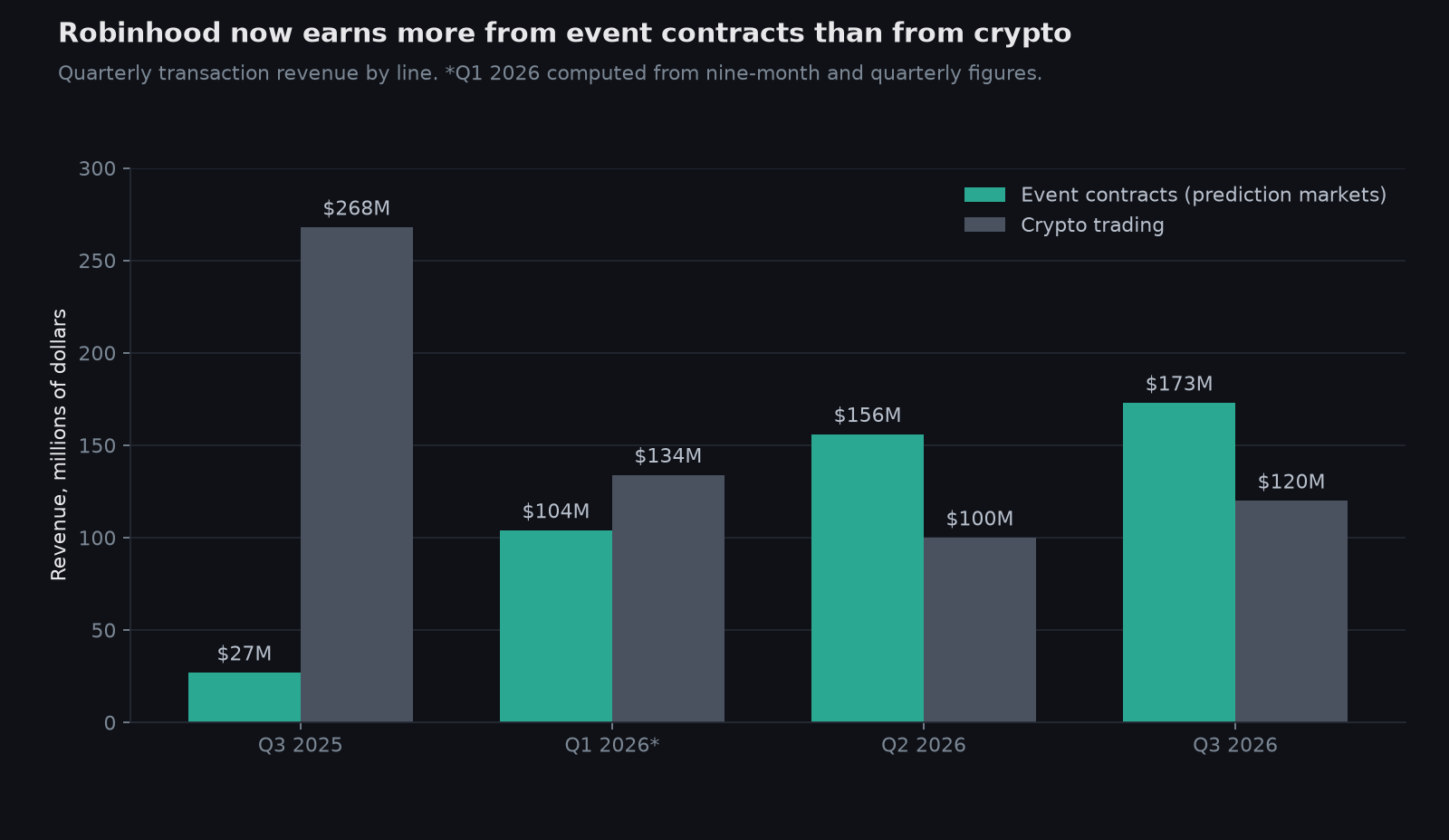
Robinhood earned $173 million from event contracts last quarter, against $120 million from crypto, and most of that growth came from sports wagers, the company said in its quarterly filing. Event contracts let customers bet on the outcome of a game, an election or another event. Exchanges such as Kalshi list them as derivatives under federal commodities law, which the companies argue puts them beyond the reach of state gambling laws.
But those sports contracts are now being shut off in a growing list of states, whose regulators and attorneys general call them unlicensed sports betting. Two of the three federal appeals courts to weigh the question have sided with the states. Robinhood has agreed to stop offering new sports contracts in Michigan and Ohio, as it did in Nevada last year, and Coinbase stops in Ohio on Nov. 13. On Monday, Robinhood sued Missouri after the state threatened to go to court within days.
Washington, D.C., is pulling the other way. On Nov. 5, the Commodity Futures Trading Commission (CFTC), the federal regulator for these markets, told exchanges they may not block customers by state, in an interpretation that takes effect Tuesday. That leaves the companies caught between a regulator that wants them in every state and courts that have ordered them out of some.
For investors, following the sweeping midterm elections that put Democrats back in power in several states, the question is how much of this business depends on federal law winning, and which dates will decide it, from the CFTC’s December deadline to a Supreme Court that could take up the question in January.
Robinhood’s Event-Contract Revenue Grew Sixfold in a Year
Event contracts went from a side product to one of Robinhood’s main revenue lines in a year. The line brought in $27 million a year earlier, its filings show, against $173 million in Q3 2026, about 12% of total net revenue. Crypto trading fell to $120 million, from $268 million, in the same quarter.
Coinbase sells Kalshi’s contracts to its customers and says the business has passed $200 million in annualized revenue, a run-rate it gives in place of a quarterly figure. At Coinbase’s third-quarter pace, that is about 4% of its revenue, by our count. Its mix also leans less on sports, with Chief Financial Officer Alesia Haas saying on an earnings call that “more than 50% of contracts traded were non-sports.”
Kalshi, which is private, was valued at $40 billion in a $1 billion round that closed Oct. 29. Its October volume hit a record $98.2 billion, according to an analysis of its trading data.
Polymarket, Kalshi’s main rival, came to U.S. sports later. Its federally regulated U.S. app began opening to a waitlist in December 2025, nearly a year after Kalshi’s first sports listings went live. But it is in the same state fights. Wisconsin sued it in April, Kentucky in June and New York in September, and Polymarket is suing Ohio rather than stop offering sports contracts there.
Two of Three Appeals Courts Side With the States
The appeals courts have mostly sided with the states. In April, the Third Circuit found Kalshi had a reasonable chance of winning its argument that federal commodities law overrides New Jersey’s gambling law. The Ninth Circuit went the other way for Nevada in August. In September, the Sixth Circuit held that federal law “neither expressly nor impliedly preempts Ohio’s or Tennessee’s gambling laws.” And on Nov. 3, the Second Circuit refused to pause New York’s and Connecticut’s actions against Kalshi and Coinbase during their appeals.
States have used those rulings to push the companies out. A Michigan court has ordered Kalshi to block residents from sports contracts, with fines of up to $500,000 a day, and Robinhood, Coinbase and Polymarket each agreed to halt sports contracts there. Ohio’s casino regulator sent cease-and-desist letters to 10 operators in October. A federal judge in California barred Kalshi from offering sports contracts on two tribes’ lands. And Arkansas sued Kalshi on Nov. 4, with Attorney General Tim Griffin saying that “Arkansas law is concerned with substance, not semantics.”
Robinhood’s agreements trade a halt on new sports contracts for each state’s promise not to enforce its gaming laws while the appeals run. The company has warned investors it may “stop offering certain new event contracts” in more states.

In the rest of the issue, subscribers get:
-
- What the CFTC’s interpretation actually requires of exchanges and of brokers like Robinhood, and why it runs into court orders already in force
- What Democrats in Congress can and can’t do to prediction markets and to CFTC Chairman Mike Selig
- How the Supreme Court could take up the cases, and the earliest dates it could act
- How much of Robinhood’s and Coinbase’s revenue rides on the outcome, with ranges for Robinhood’s event-contract line
Already a subscriber? Keep reading.

Grab the limited-time offer!
Subscribe to read the rest.
Get a 2-week free trial
Renews at $25/month
UpgradeWhy serious investors subscribe:
-
Clear thinking during macro regime changes
-
Fewer trades, better decisions
-
Avoiding one bad allocation often matters more than finding one great trade