


Strategy built STRC, a preferred stock that pays 12% a year, to raise money for bitcoin. It hasn’t raised any since May.
In late June, STRC closed as low as $74.57, roughly 25% below the $100 price it was designed to trade near. Strategy started buying it back in late July and has kept buying every week since, spending $1.6 billion, by our count of its weekly filings. On Tuesday, STRC closed at $99.90. Last week was Strategy’s heaviest week of STRC buying yet: $192.4 million on STRC, about nine times what it spent on bitcoin.
STRC is now within 10 cents of its $100 target, and under its current policy Strategy won’t sell a new STRC share until it gets there.
Preferred stocks like STRC exist to raise money. When STRC trades at or above its $100 stated amount, Strategy can sell new shares, pay buyers a dividend twice a month, and use the cash to buy bitcoin. It was still working in mid-May: Strategy’s last sale came in the week of May 11, when the company raised about $1.95 billion. Then STRC closed below $100 on May 15, and the sales stopped. Our Aug. 6 issue listed among the things to watch whether Strategy’s buybacks could keep pushing STRC toward $100, and STRC has nearly gotten there.
So is the buyback loop running out of cash? Not quite. The board has authorized a budget for buying back Strategy’s preferred stock that will run out in about two weeks (if purchases remain at last week’s pace). But the board can raise that budget, as it did in September, when it doubled the authorization to $2 billion. The cash Strategy spends on the buybacks can be refilled too. At last week’s pace it would last a little over three weeks, and Strategy, notably, has paid for the buybacks mostly by selling MSTR shares, either directly or through a cash pile built from those sales, and it can sell more.
Strategy built itself into the largest corporate bitcoin holder on the theory that dollars would lose value in the long term and that investors wanted access to a leveraged bet on bitcoin. It launched a series of preferred stocks to raise money for more and more bitcoin purchases.
But STRC has become something the company now spends money to support. Much of the money from MSTR sales has gone to retiring STRC rather than buying bitcoin, and this summer the company even sold bitcoin to help pay for the buybacks. As long as MSTR trades above about $131, that does not hurt MSTR holders on a net basis, but it turns MSTR into a less leveraged bitcoin bet.
How Strategy Bought STRC Back Toward $100
Strategy described a measured approach to its support of STRC in its second-quarter earnings release, when the buying began. The company said it would keep purchasing while STRC traded below $100, “buying more at deeper discounts and tapering as STRC approaches par.” Its first week, in late July, was cautious, about $25 million of STRC at roughly $87 a share on the open market. From there the weekly checks grew as the price climbed. Last week Strategy paid an average of $99.58, inside the $99 to $100 range it calls its objective.
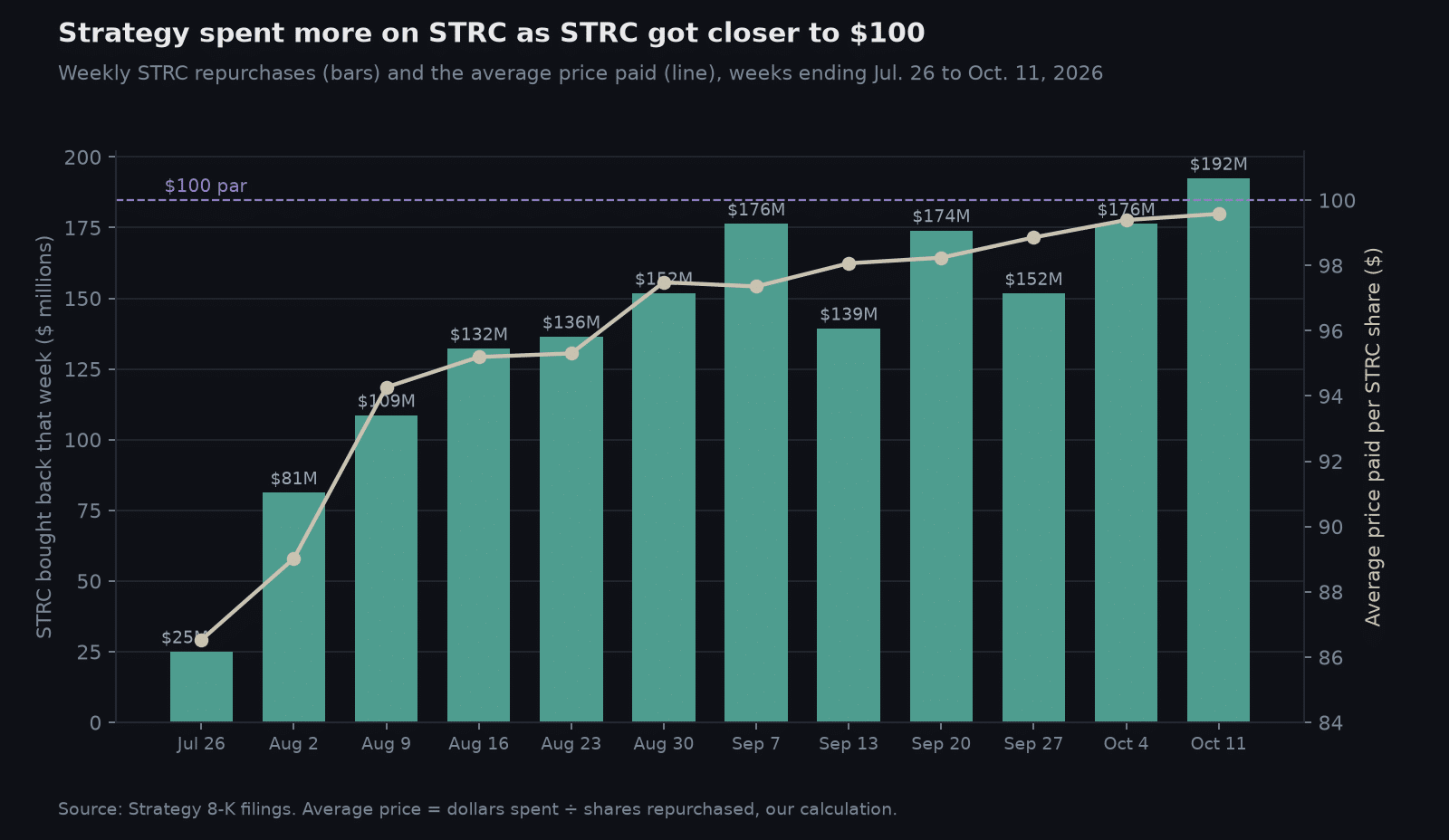
By nature of this plan, Strategy has also become a major presence in STRC’s market. Its repurchases made up roughly a fifth to a quarter of STRC’s weekly trading in September, according to Keyrock, a crypto market maker. Keyrock said its data can’t show how much demand would remain without that support.
In the rest of the issue, subscribers get:
-
- What Strategy gets for $192 million a week at $99.58, and why $100 is the price that matters
- Where the money has come from since July, including MSTR sales that went straight to STRC
- Why, on the net measure, selling MSTR to retire STRC does not dilute holders at today’s prices, and what it costs them anyway
- What Strategy owes STRC holders if it walks away and STRC slides back from $100
- Bull, base and bear ranges for STRC and MSTR, and the dates that decide between them
Already a subscriber? Keep reading.

Grab the limited-time offer!
Subscribe to read the rest.
Get a 2-week free trial
Renews at $25/month
UpgradeWhy serious investors subscribe:
-
Clear thinking during macro regime changes
-
Fewer trades, better decisions
-
Avoiding one bad allocation often matters more than finding one great trade