
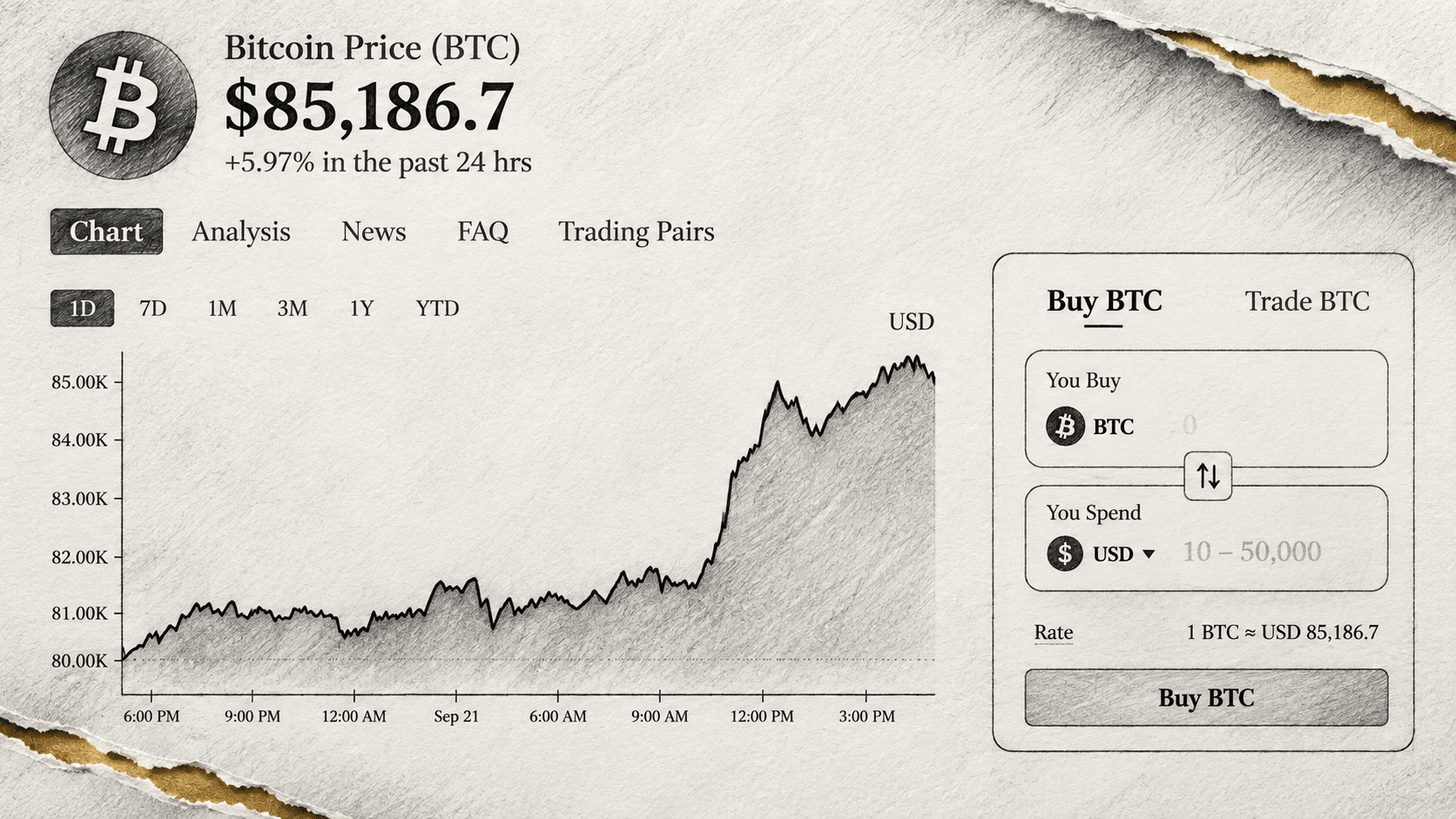

Bitcoin traded above $85,000 on Monday for the first time since January, and the move came at the expense of traders positioned against it. Short positions worth $634.7 million were liquidated across crypto markets over the preceding 24 hours, against $121.3 million on the long side, according to CoinGlass data read at 11:25 a.m. UTC.
Forced closures across all assets totaled roughly $756 million and caught 114,385 traders, CoinGlass said, including an $11.29 million BTCUSDT position on Binance. Bitcoin accounted for $367.1 million of the short-side damage and ether for $154.2 million. Market-wide open interest still rose 8.07% to $155.7 billion, and 24-hour volume jumped 57.96% to $235.7 billion.
Ether was up over 5% at over $2,700, solana over 7% at over $116 and XRP nearly 8% at $1.49, according to CoinGecko data.
Bitcoin Closes a Week Above Its 50-Week Average
Alex Thorn, head of firmwide research at Galaxy Digital, said in a post early Monday that bitcoin had closed the week above its 50-week moving average for the first time in 45 weeks. Regaining that level “has historically served as strong confirmation that bear market lows are” in, he wrote, adding that bitcoin was up 29% in 35 days.
Bitcoin hit a recent low of $74,977 on Sept. 15 and has gained about 13% since. It is still down roughly 3% on the year and sits about 33% below the record $126,080 it reached in October 2025. Friday’s leg pulled U.S. spot bitcoin ETFs back from a second consecutive week of net outflows, with $433 million of inflows turning the week positive by $6.2 million. Bitcoin had climbed back above $80,000 once already this month, on Sept. 4, before losing the level again.
Oei Sees a New High Against the S&P
Khing Oei, founder and chief executive of Dutch bitcoin treasury firm Treasury, pointed to a different marker in a post on Saturday, before Monday’s move. “Bitcoin printed a new high against the S&P this week after months of trading like a low volatility gold proxy,” he wrote.
“A rally that starts from compressed volatility and a crowded gold correlation is driven by allocation, and allocation moves slowly and then all at once,” Oei wrote in the same post.
Related Listen: How Cory Klippsten Would Decide How to Secure Bitcoin Post-Coldcard