


Ether’s (ETH) demand this year has largely come from two places: spot exchange-traded funds (ETFs) and Bitmine Immersion Technologies (BMNR), the company building an ether treasury. In October, both are pulling back at once.
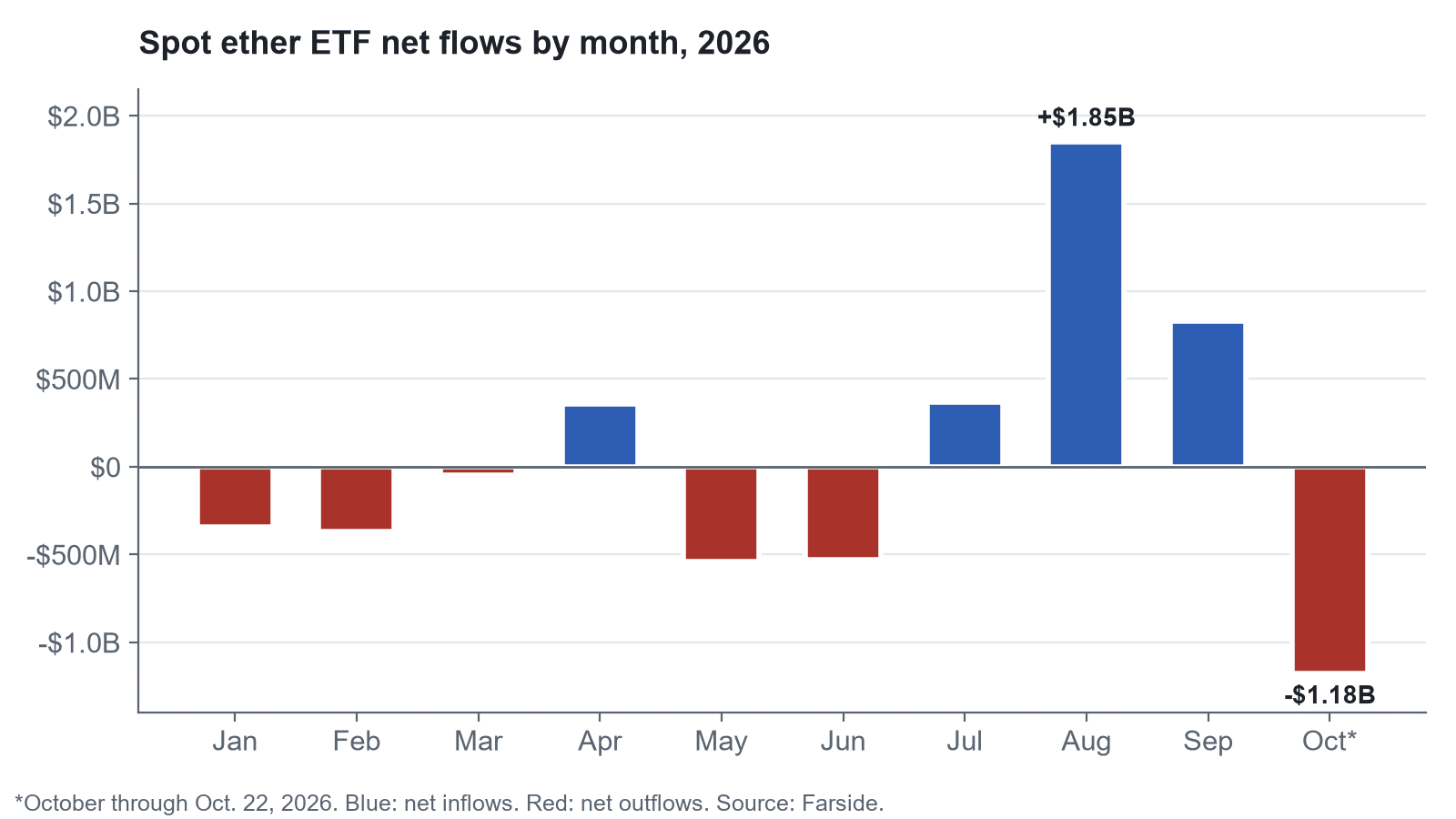
No month this year has seen spot ether ETFs lose as much as October, with $1.2 billion in net outflows so far. Investors pulled money on all but two trading days through Oct. 22.
Bitmine, meanwhile, is about 66,000 ETH short of its goal of owning 5% of all ether, by our count from its latest holdings update. At the company’s current pace, it hits its target late next month.
Ether bulls often parse their outlooks through adoption headlines, like JPMorgan bringing its deposit token to Ethereum this week. Adoption builds the network, but it only lifts the price when someone buys the coin. Presently, the question is who absorbs the roughly 20,000 new ETH the network issues every week once Bitmine stops.
This issue of Bits + Bips measures how much of that supply Bitmine has been taking, why no other ether treasury can take over, and what ETF flows would need to look like for ether to hold up into year-end.
Bitmine’s Buying Has Already Slowed
Bitmine is finishing its accumulation at a fraction of the pace it started with. The company has bought ether every week since June 30, 2025. In April and May it bought more than 100,000 ETH in a single week four times. In each of the last two weeks it bought about 12,500.
It now holds 6.04 million ETH, or 4.9% of Ethereum‘s circulating token supply, and its cash has fallen by about $30 million a week with no new capital raise in its last three updates.
“We’re done stacking,” Bitmine Chair Tom Lee said earlier this month in a message to investors.
Bitmine’s 5% ether target is “a hard cap,” Lee said at the Token2049 conference, adding, “We’re not gonna be accumulating past 5%.”
One caveat on timing: 5% of ether’s supply is a moving target. Supply grows by about 87,000 ETH a month, so the finish line moves out by roughly 4,300 ETH a month, by our count.
Additionally, Ethereum’s issuance is subject to change, and not fixed at roughly 20,000 new ETH per week. The network uses a fee-burning mechanism that dynamically adjusts to user demand. At times of high use, like in 2023, this mechanism burns more tokens than are created to pay the validators that secure the network, actually turning Ethereum’s token economy deflationary. That said, ether token inflation has stayed relatively stable this year, in part due to a migration of user activity onto Layer-2 networks, which has left mainnet gas fees too low to burn off the newly issued coins.
ETF Money Moves in Billions
The ETFs have been the larger and less predictable buyer this year. Net inflows reached $1.85 billion in August and another $832 million in September, then reversed in October.
The funds now hold roughly 6.2 million ETH, about the same as Bitmine, from their combined net assets of $14.6 billion. However, the two buyers move at very different speeds. October’s outflows have averaged about $357 million a week. Bitmine’s recent purchases come to about $30 million a week at its own reported prices. The ETF swing is about 12 times larger.
In the rest of the issue, subscribers get:
- How much of ether’s new supply Bitmine has been absorbing, and why part of the hand-off has already happened
- Why no other ether treasury can step in, judged by what their shares trade at against their coins
- What is driving October’s ETF outflows
- The weekly ETF number that would cover ether’s new supply after Bitmine stops, plus bull, base and bear ranges for ETH into year-end
Already a subscriber? Keep reading.

Grab the limited-time offer!
Subscribe to read the rest.
Get a 2-week free trial
Renews at $25/month
UpgradeWhy serious investors subscribe:
-
Clear thinking during macro regime changes
-
Fewer trades, better decisions
-
Avoiding one bad allocation often matters more than finding one great trade